
The story
Where this came from
vmctl was not designed. It was forced into existence by an exhibition — and by works of art that refused to run.
An exhibition as crucible
In 2025 ZKM | Center for Art and Media Karlsruhe opened Choose Your Filter! Browser Art Since the Beginnings of the World Wide Web: some thirty works spanning 1996 to 2025, running daily for six and a half months. The curators came from research, not conservation, and they brought — by their own account — three misjudgements. First: it’s a small undertaking. It was thirty-five software works, every one of them maintenance-hungry, every one supposed to be online. Second: ZKM’s hardware stores are inexhaustible. They are not; the show ended up competing with the collection exhibition for monitors. Third, and most consequential: ZKM will sort it out. It had never occurred to anyone to exclude works that no longer ran. On the contrary — the wishlist was drawn up precisely so the curators could finally experience the works they had never managed to get running themselves.
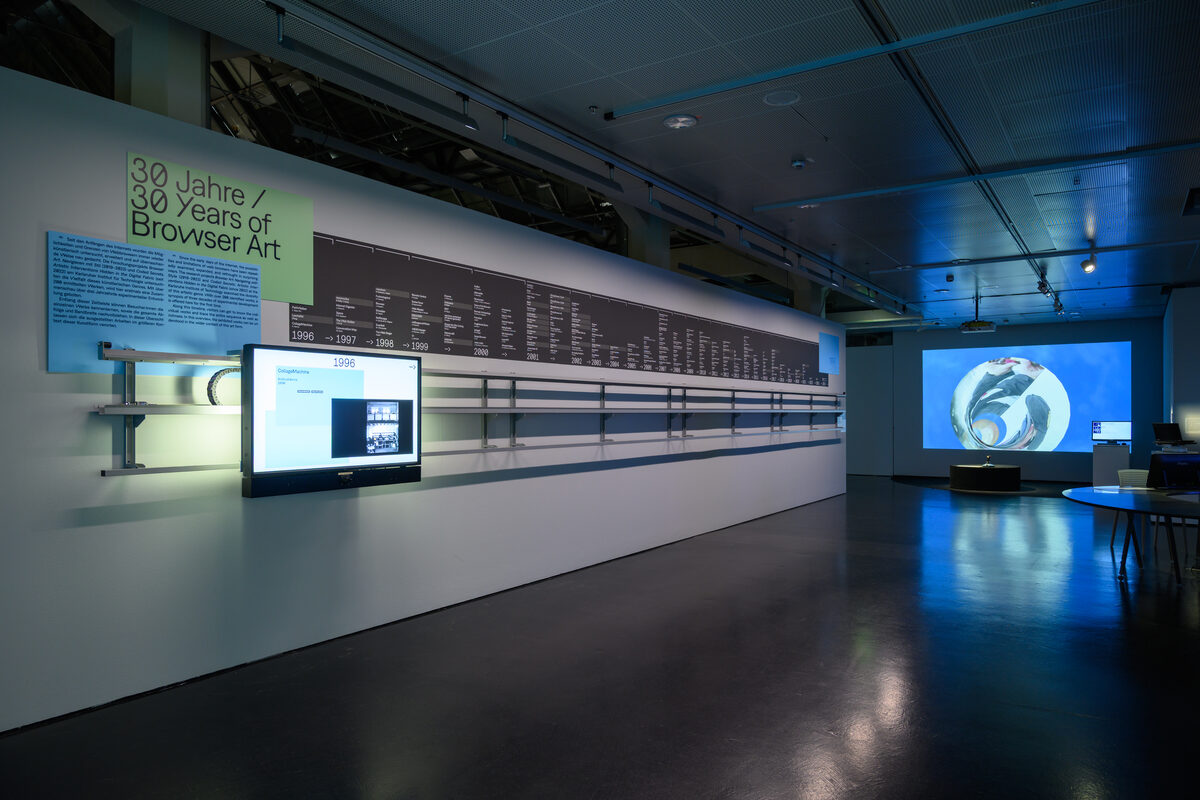
That third naivety is where we come in — the museum-technology side of the story. The exhibition handed us works written for a specific historical configuration of browser, plugin, operating system, and server landscape, and demanded that they function in a present where that configuration no longer exists. And function unattended: survive crashes, reset their own state, compensate for servers that are gone — six months, opening hours, no hand on the machine.
Eden.Garden, a detective story
The hardest case was Eden.Garden 1.1 (2001) by Entropy8Zuper! — Auriea Harvey and Michaël Samyn. The work had been dead since 2002. What remained: a documentation website, mentions in a YouTube video, screenshots, a few seconds of moving image. Why it died: the Pulse 3D browser plugin was discontinued and its vendor gone; the server-side script the work talked to had vanished; the original files were scattered across private collections.
A colleague found a hint in a forum. After several dead ends, the abandoned plugin surfaced via LostMediaWiki and the Internet Archive. We built a Windows XP virtual machine that was, as exactly as we could make it, the computer the work expected. Adam and Eve appeared on screen — and hung.
The breakthrough came from the work’s age. 2001 is pre-HTTPS; everything the work
said to the network, it said in the open, unencrypted. So we put a listening tool
(mitmproxy) between the virtual machine and the internet and read along: the work was
calling a small server program, a Perl script named
gettext.pl, on a server that answered 404. And then the punchline that
justified the whole approach — the original server, in its error state, returned
its own Perl source as the error page. The bug was the
documentation. We rebuilt the server locally from its own accidental
self-disclosure, and the work ran — for the first time in more than twenty years.
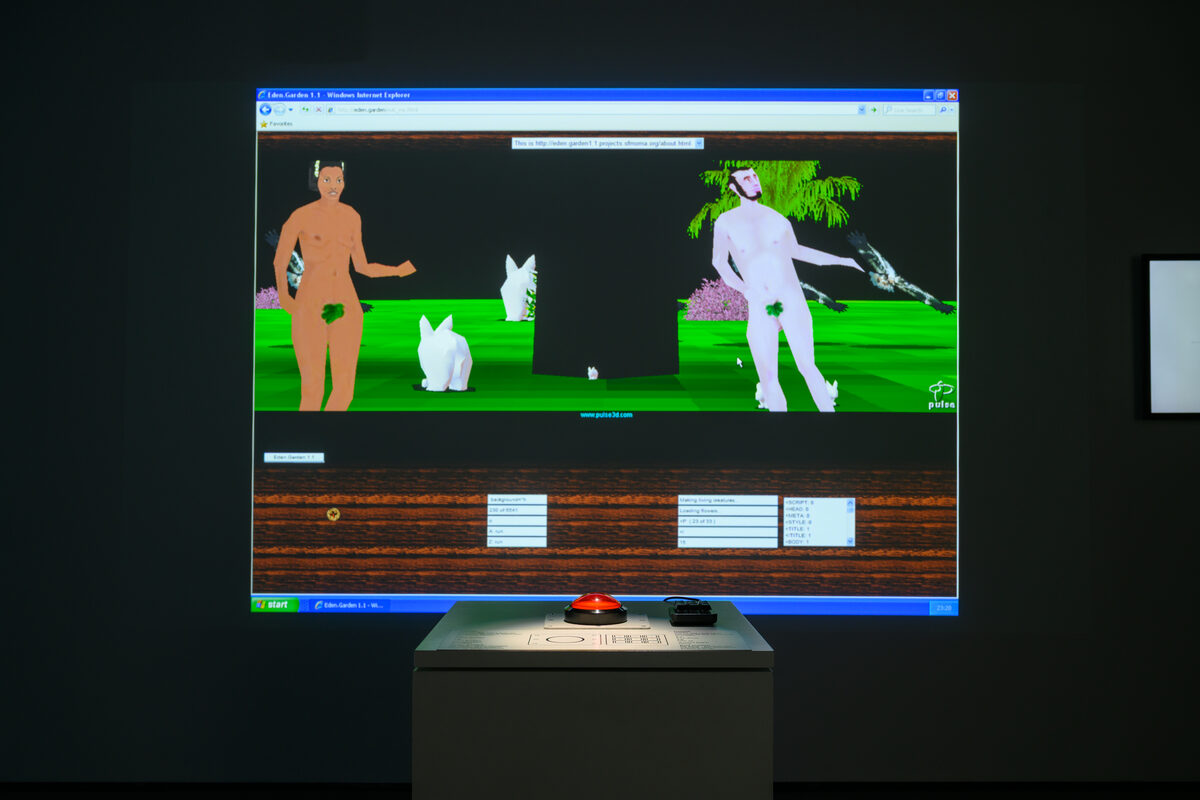
There was a video call where the artists saw their work again. And there is an institutional coda: a joint acquisition with SFMOMA in which the restoration itself — the machine, the rebuilt server, the conditions of the work’s running — is collected together with the work. The work and the conditions of its revival, acquired as one thing.
Built for one work. It ran for eight.
ZKM’s standard instrument for keeping works alive on public gallery computers had been small Windows automation scripts (AutoIt) that restart a work when it crashes — usually enough, not always enough; when the whole computer goes down, the recovery script goes down with it. The Eden.Garden machine forced a different idea: don’t repair, reset. Snapshot the whole running system — memory and disk — and on any failure revert to it: the entire machine back in three to five seconds, no boot. Around that grew a heartbeat from inside the guest, a process watchdog, and an idle timer calibrated by standing in the room and watching visitors.
We built that controller for one work. By the end of the run, the same XP machine lineage — internally still named after Eden.Garden — carried eight: Peter Luining’s ZNC browser, JODI’s Wrong Browser series, Reconnoitre, earshot, three of Mark Daggett’s Browser Gestures. A new work meant, in practice: a different executable and a small script. The host logic never changed. That was the first hint that we were no longer maintaining an exhibition — we were accidentally building an instrument.
Not everything was revival. The modern works — browser-extension pieces — needed the opposite: not a frozen snapshot but ongoing care. Cookie banners, abandoned sessions, tab pileups; a tending task, not a resurrection task. And the field is collaborative by necessity: the Mac OS 9 base for Thomson & Craighead’s e-poltergeist came from Rhizome, ZKM added the audio path, restorer Matthieu Vlaminck did the in-work automation. We would not have managed it alone in eight months — and a Mac OS 9 virtual machine ended up triggering a strategic collection partnership.
The honest limit
One work refused every one of these strategies. Shane Cooper’s Remote Control (1999) runs on original SGI hardware doing realtime speech analysis; no virtualisation carries it. No self-healing, no snapshots. We kept that work alive through six months of exhibition by human attention — daily checks, not software. It stays in the story because it is the clamp on every claim we make: every type of work needs its own conservation strategy, and some of them are not this one.
The tools escape the exhibition
The exhibition closed in August 2025. The tools did not stop. In December 2025 the exhibition controller went open source (MIT, on ZKM’s GitHub); the supporting cast followed through the spring — DNS interception for vanished servers, a proxy answering from the archived web, a survey of how much of the net-art era is still reachable at all. Then, in June 2026, the pivot from running exhibitions to research: first the Research VM Controller, the workbench — because keeping one known-good state alive and opening a work up to study it are opposite jobs — and days later artwork-autopsy, automated understanding, because the dependency that kills a work is usually the one that is not visible in its files. In July 2026 we published the whitepaper as a draft, early and deliberately unfinished.
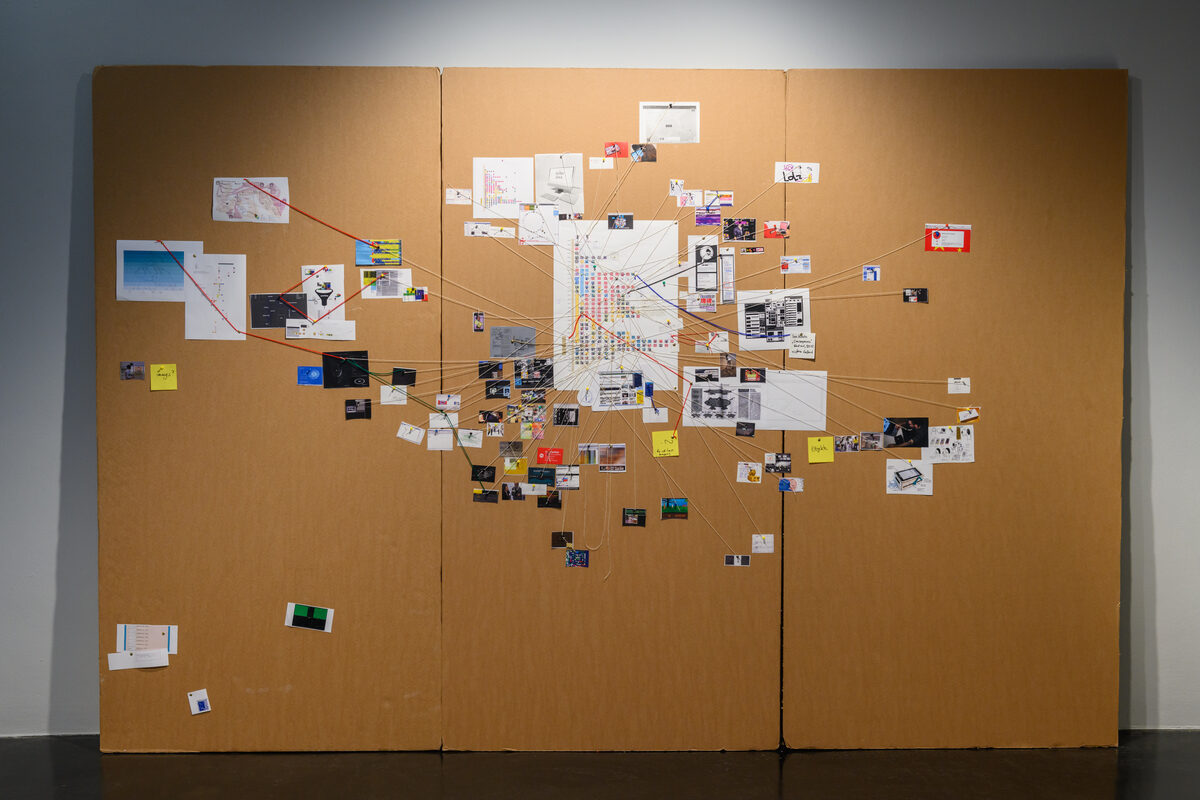
That is the honest shape of this project: one exhibition’s emergency, generalised. We built these tools because we needed them, we proved them on real works in a real gallery, and we publish them because the next museum facing a dead artwork should not have to start from a forum post and a hunch. If you hold such a work — this is where you come in.